Composition Work
Driven by passion, built through creativity and craft, Kacie has authored recent works of fiction, creative nonfiction and commentary
New!Class Projects
Meritocracy of the Mirror
By Kacie M Doran
There’s a new meritocracy in town, and it measures in macros. You can’t log into Instagram, Facebook, X or Tiktok without someone giving you advice on how to be thinner, smoother, hotter and more stacked. Somewhere between collagen and capitalism, we decided the body was proof of character. The new Instagram thread I’ve been seeing is: “Your body is your résumé,” as if collagen were a credential. The hilarious part is, so often it’s a video of a 22 year old bragging about their gym schedule. Let me tell you something: it’s effortless to be hot at 22. You can eat donuts every day and look like a Victoria Secret model. Stop taking credit. Young influencers often share their skincare routines, swearing by the magical properties embedded into their night serums, such as Valencia Nathania or Ria Amin.
It’s not just Gen Z. Influencers across all spheres of influence, generations and continents are vying for the guru beauty and wellness genius embedded within their channels. They all offer the secrets to the perfect face, the perfect stomach. How to keep your man. As if the kind of true love you want in life should be able to fluctuate with your aesthetic appeal on a day to day basis. What appears to be a culture of wellness and discipline is, in fact, a system of contingent self-worth that equates appearance with value and confuses youth with merit; by moralizing beauty and aesthetic discipline, digital culture has transformed the body into a résumé that rewards biological luck while punishing natural aging as failure. Look at the way they poke at Sally Field!
We have utilized communication to the point of crippling self-interest, transforming digital space into a marketplace where self-improvement is not optional but compulsory. There are incessant ads for whiter teeth, more radiant skin and workout programs. What’s really become an internet phenomenon is the fitness influencers. Many are just regular moms posting a video about how wonderful life is to wake up at four in the morning and go to the gym or run five miles in the freezing snow before their two year old wakes up.
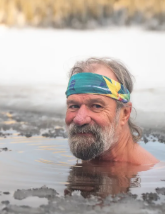
Don’t forget the cold plunge. You’re not living up to your best self unless you’re jumping into an ice cold tub in 23 degree weather at sunrise. There’s an entire subculture dedicated to it such as youtube channels “Frozen Enthusiast” and “Chill Vibes.” Influencers like Wim Hof offer guidance in “mental toughness,” metabolic enlightenment, and the vague but powerful suggestion that plunging into freezing water before dawn might unlock a superior, morally purified version of yourself.
Look, don’t hear what I’m not saying. I love surfing in the winter; cold water at sunrise feels fantastic. I surfed the North Atlantic off the coast of Donegal, Ireland. I get it. I’m not criticizing the practice itself so much as the digital evangelism surrounding it, being the strange insistence that unless we, too, are plunging ourselves into an ice bath before dawn, we are somehow failing to live up to our full human potential. The videos never show you the six coffees they need to get through the day after that. On a side note, I would just like to ask if you know what else feels as good as toned arms or jumping into a tub filled with freezing water at 4 AM, if not better? Three extra hours of sleep each night and a face that isn’t suffering from sleep deprivation induced cellular oxidation.
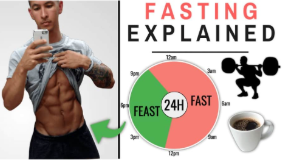
And don’t even get me started on fasting. It used to be a spiritual discipline rooted in humility. Now it’s a metabolic flex. Autophagy has become the new atonement. Instagram is overflooded with the benefits of autophagy and why not eating is so good for you. We deny ourselves carbohydrates not out of reverence, but out of aesthetic ambition. So not only should you get up at four in the freaking morning to workout and take a cold plunge, but don’t you even think about breakfast. I’m not saying fasting is bad. I’m a fan. I’m merely skeptical of the growing implication that if you ate breakfast, you have somehow failed at life.
We now live in a culture where even hunger must be optimized, where the absence of consumption is reframed as productivity. It is no longer enough to exist; one must metabolize existence correctly. You haven’t truly contemplated existence until you’ve tried to answer emails while fasting, mildly hypoglycemic, and quietly resenting the coworker eating a bagel. Influencers like Sumaya Kazi offer “fast with me” motivation to help you out. I suppose there’s a special kind of existential clarity that comes from low blood sugar.
.
Sartre called other people hell. Perhaps he meant the constant awareness of being seen. He clearly wouldn’t have enjoyed scrolling Instagram before breakfast, where a stranger in Arizona is already documenting their sunrise routine and somehow you feel personally evaluated by a person who has never met you. Michel Foucault argued that modern power functions through internalized discipline rather than overt coercion; the fasting body becomes both prisoner and guard, policing itself in pursuit of moral and aesthetic compliance. No one is forcing you, of course. The phone simply sits there quietly, radiating the vague but powerful suggestion that other people are doing life more correctly than you are.
In his later lectures, Foucault describes “technologies of the self,” practices through which individuals shape their bodies and identities in pursuit of socially sanctioned ideals. Social media has turned this into a kind of daily performance review, except the manager is a thousand semi-acquaintances and one particularly judgmental former high school classmate who now does yoga on a cliff somewhere in Sedona. What once might have been spiritual asceticism becomes, in digital modernity, aesthetic engineering. When visibility becomes currency, the body becomes a status signal—less a home for consciousness and more a résumé with skin.
As Alain de Botton argues in Status Anxiety, modern societies relocate honor from birthright to achievement but in doing so intensify personal insecurity. In a culture where beauty reads as discipline, aesthetics become a proxy for worth. Self worth tied to appearance is nothing new. Psychologists Crocker and Wolfe describe self-worth as contingent, tethered to specific domains like appearance. When the body becomes the primary site of value, esteem rises and falls with every mirror.
The meritocracy of the mirror does not stop at capitalism; it now borrows the language of sanctification.
Just this morning, I saw a video clip of a soldier running on a treadmill on the beach (yes, a treadmill on the beach) because the sand was apparently not good enough. Get this, the guy was holding a giant wooden cross. The audio was about how you “need to be fit for God.” He was selling fitness discipline as the literal cross you must carry to follow Christ. And for only 4 installments of 29.99 I’m sure, you can subscribe to his program for self-achieving holiness. And a six-pack.
Influencers like Garrett White of Wake Up Warrior and the KingsKit program push faith and masculinity, physical fitness as spiritual leadership, cold plunges and extreme routines, saying that “The body is the first kingdom you must conquer.”
What masquerades as discipline is often self-surveillance, a phenomenon Fredrickson and Roberts describe as internalized objectification, which is basically the body being policed from within. This is particularly strongest in females, “Objectification theory posits that girls and women are typically acculturated to internalize an observer's perspective as a primary view of their physical selves” (Frederickson & Roberts, 2006). Constant body ideology on social media scrolls doesn’t help. Research consistently shows that exposure to idealized bodies online increases dissatisfaction and appearance comparison. In other words, the algorithm doesn’t just sell products, it sells inadequacy.
The tragedy of the meritocracy of the mirror is not simply that it confuses youth with virtue; it is that it promises control over what is fundamentally uncontrollable.
It tells us that your body, your blood sugar levels, your abs, your toned biceps and thighs, are the measure of a life. Worth becomes quantifiable in macros and muscle definition, as though what your husband thinks of your ass somehow outweighs the deeper question of why you draw breath at all. Health, exercise, and fitness are good things. I love those things. But when physical appearance becomes evidence of self-determination or moral worth, something deeper is quietly displaced. The question of meaning, of what we are here to contribute, shrinks beneath the relentless project of managing the body. And yet the body was never meant to carry that weight. Time will erode collagen. Biology will shift. Skin will loosen. Injuries will happen. Some days the gym is closed, the trail is flooded, the plane lands too late, or the body itself simply refuses to cooperate. Eventually, for every person who has ever lived, the body will fail entirely. Every one of us will be buried, burned, or returned to the earth in some other form.
The algorithm will move on to a younger face, a sharper jawline, a newer body to celebrate. When that moment arrives, the system offers no consolation, only a new serum. So what, then, are we contributing? Status anxiety and shame? Or are we feeding the world with what it is actually starving for: purpose, wholeness, love, acceptance, the provision of basic human needs? Because when the mirror finally loses interest, the only question that remains is what we have left behind, whether we spent our brief moment on earth perfecting the body, or offering something of the soul.






Writing for the Web: Autobiography
My life as a writer for the web began before I knew what writing was supposed to be for. It began in kindergarten in the late 80’s with a fascination for typing, not the content of what I was writing, but the speed, the rhythm, the feeling that my thoughts could outrun my hands if I practiced hard enough. I wanted to be fast! My WPM makes for good resume banter, anyways.
By elementary school, in the early nineties, my work lived on floppy disks: actual, bendable squares that felt both precious and extremely fragile. We learned email slowly, mechanically, as if it were a novelty rather than a future. Each message felt ceremonial. The internet existed, but distantly, like weather on another continent. It wasn’t yet a place you lived.
By high school, in the late nineties, we were typing papers but still printing them out, the web hovering nearby but not yet authoritative. Y2K was a huge scare. I can still remember how my best friend’s parents thought the world was going to end. We got our first home computer when I was about thirteen. I used to check my email every night when I got home, like it was a private ritual. My brother was always recalibrating something, some setting he’d discovered and couldn’t leave alone. He got in trouble for it constantly. I escaped instead, slipping into AOL chat rooms when I couldn’t sleep. This began my freshman year of high school. Still, the internet still felt optional then. We spent most of our time hanging out, going to the beach, the mall, parties, live shows, skateboarding near the stores our friends worked at. Going to Subway. Choking each other to pass out like idiots. Snorkeling in the keys, surfing at Cocoa Beach. Drinking malt liquor at the park. Well, to be honest, I usually sprung for Heineken because let’s face it: I had standards. At least we were engaging in teenage precariousness in person. I don’t think any of us knew how much the web would soon become a compulsory part of our lives, with our mobile devices connected to it, turning us all into fucking cyborgs.
I was in an exploration stage online when I did log in. I read blogs. I talked to strangers. I discovered punk rock through sounds my friends’ CDs had never introduced me to. They were a mixture of Irish dance friends, soccer friends, debate team nerds that gave me the intellectual stimulation I didn’t always get from my absolute besties, my surfing, skating, art-making burnout loves. We skipped school, we surfed, we got stoned, we laughed, we lit stuff on fire. At my first high school, I was on the Varsity Debate team, in addition to being a prizewinning Irish dancer, a runner of Track & Field, and member of The Gaelic Club and Drama Club, hence my different friend groups. They arrested me freshman year in the late nineties, after performing a treble reel at the Multicultural Assembly for giving a Ritalin I didn’t want to another student who was more interested in its effects than I was. Being so involved in school and getting kicked out was an interesting dichotomy. There was a lot going on at home. I wished someone had asked.
Later, I used the internet to discover death metal and black metal in bands like Cradle of Filth, which, in retrospect, may have been a rehearsal for the boy I dated at fifteen. He was a black metal drummer in his 20’s. Anything that could’ve pissed my parents off was pretty coveted at that age. My bedroom walls were papered with band posters printed from the internet, autographed concert tickets taped beside them, and a guitar my uncle gave me.
The web became a place where the grief of existence could sit without explanation. And honestly, I was able to find artistry I wasn’t exposed to day-to-day. It gave me a sense of independence. I fell in love with sounds from Stiff Little Fingers and many others. I LOVED being able to share my poetry with other human souls. I wound up at an alternative school that year, until I began making friends. That was a problem. Sophomore year, I enrolled in a charter school. That gave rise to my second expulsion the year when my brother, also a sophomore, went into cardiac arrest in June of 2000. I was at the park drinking with my friends one day when I got picked up to go to the hospital. My brother stopped breathing. Seventeen was a shit age to die and fifteen wasn’t an improvement to be holding his hand, feeling it go limp into my palm.
After wandering around with friends who didn’t have the best life intentions, I was sent to study in Ireland where I surfed off the coast of the Donegal in Bundoran, Ireland. I visited my family in Northern Ireland after that, completely unplugged from the web. Right after I got home, 9/11 happened.
I met my first boyfriend on AOL when I was sixteen. He was forty-six. Looking back, I am thoroughly creeped out. I didn’t meet him in person until I was seventeen, pretending to be eighteen. If that makes a difference. And when he found out, he did not care.
Deeply, profoundly gross.
At the time, there were essentially no guardrails. It was the dawn of the 21st century. There was no real language for what was happening, let alone protections against it. I heard stories about my friend’s dad talking to young girls in chat rooms, the same parents who were convinced the world was about to end any minute now.
The internet, dude. A place of infinite possibility and some truly garbage-tier consequences. Both things can be true.
Later that same year, in 2001, when I was still 16, I wrote a poetry chapbook: Primary Screams. I learned about amateur publishing online and bought a recommended book at Barnes & Noble after returning from my long trip to Ireland. It gave me time away from the web, from my friends, from grief, from myself. And from 9/11. What a mess. Every channel on the TV showed the planes as I woke up that day. Such a tragedy, it consumed every conversation. Here we are, barely a couple decades later and no one really ever even talks about it. I think I finished school from home that year. I was a good student that year too. I was on the JV soccer team. I did miss that. Online, I read poetry, philosophy and the history of language. I didn’t yet know I was being trained by hyperlinks or that curiosity itself was becoming algorithmic.
Blockbusters were still around back then. I can’t remember how, if it was online, on TV or through the web, but I got my hands on The Basketball Diaries with Leonardo DiCaprio. Every girl I knew was in love with him at the time thanks to Romeo & Juliet. For some reason, I wept for hours after watching it and then never cried again about my brother. At least not until I became a full-fledged adult and had to be reconciled with all of that. The movie had absolutely nothing to do with my brother, other than the fact that there was a teenage boy who died. Maybe that’s what did it. I sat outside by the lake behind our house and just let the tears wash my cheeks with everything I didn’t want to feel nor let myself feel again. Not until my 30s.
I went to an all girls school after the charter school, where I also got kicked out. Once I was told I couldn’t be a poet or a writer of any kind, I pretty much lost all academic motivation. I continued exploring philosophy and spirituality, reading and writing often. I got really into out of body experiences. I studied Peterson and Monroe and collected the books of the Dhammapada. Astrology. I was grasping at straws, looking for a force I knew was out there. I wanted answers.
It was still a transitional era in the early 2000’s. People kept mistaking me for Christina Aguilera. Jobs came from newspaper ads and the Yellow Pages, awkwardly supplemented by Craigslist, which at the time felt vaguely illicit. It was definitely the go-to place for questionable car dealers and sketchily-clad escort services. After my mother discouraged me from writing, I pursued finance instead. I used Google to research salaries, searching desperately for proof that I could become something respectable. My mom said I should be a medical transcriptionist. I hate that phrase to this day: medical transcriptionist. It sounds like something they write on the tombstones of people who just had no other talents in life, no shame for the medical transcriptionists out there. I just really didn’t want to be one. The internet didn’t tell me who I was, but it did tell me what I was worth.
By seventeen, I was studying commodities and mortgage systems, preparing for licensing exams while battling insomnia. Corporate software had gone wireless. I was trained up by a broker I worked for doing telemarketing in high school. I learned Calyx Point on a CD I took home from a small brokerage. I made mistakes constantly. I learned how to use the internet to find my way out of them. The web taught me something fundamental then: you don’t need mastery, just access to information, to someone who might know more than you. I was nineteen years old making seventy-thousand a year, not counting a very generous bonus package. I’d say it was worth it, if I didn’t hate it so much. You’re never good at things you hate. I thought I liked it. I really did. I spent lunch breaks in my car writing poetry, strumming my guitar that my cousin in Ireland sold me for twenty pounds, wishing for a life just out of reach. I even went into business opening up a mortgage company when I was twenty. That year, in 2004, I bought a C230 Mercedes and I felt empty. My father was dying and the years I was spending without visiting him were growing.
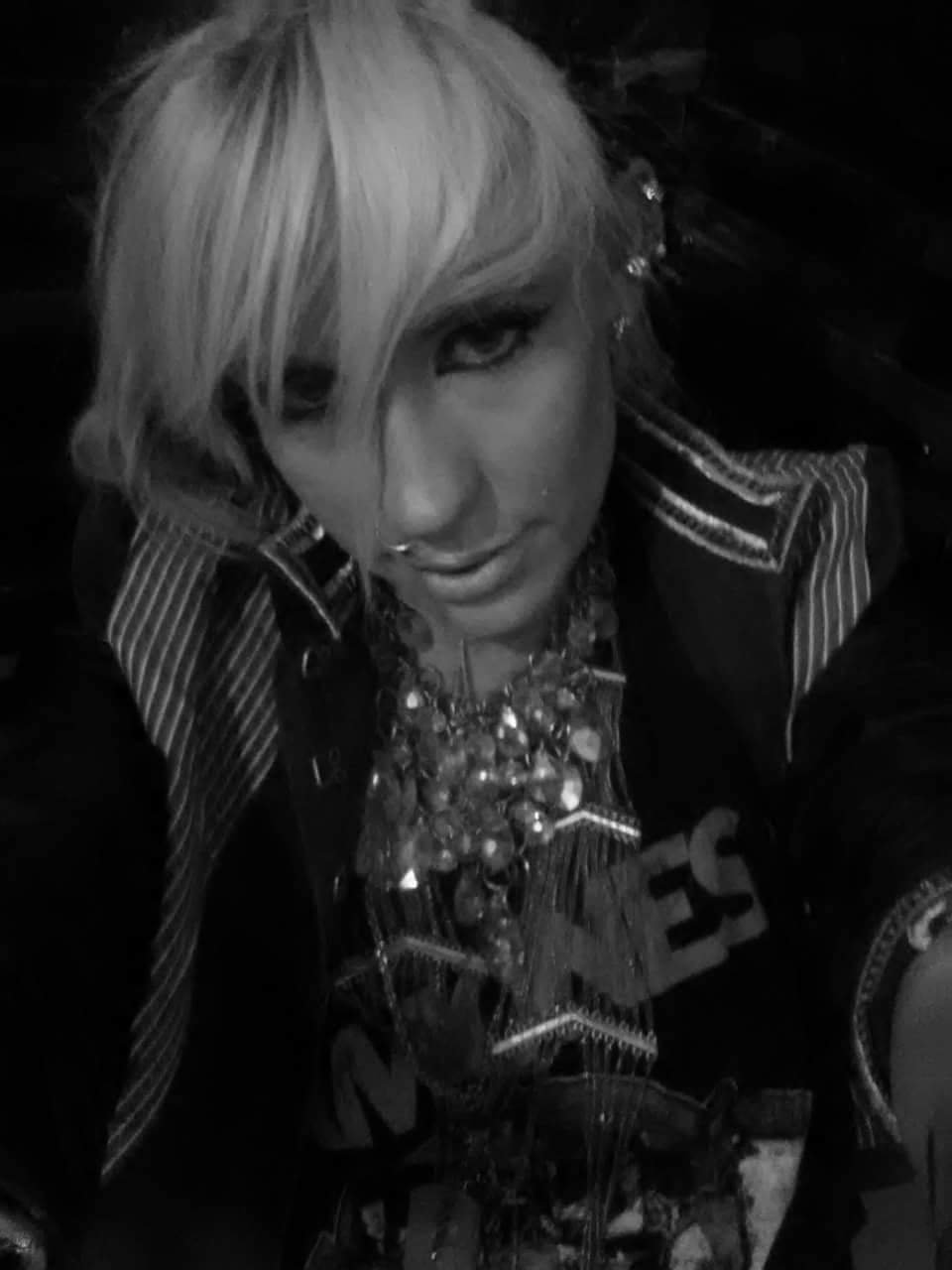
I wanted an artistic outlet. I built a MySpace filled with photos of my ventures out to Miami gothic and industrial parties, navigated by printed-out Mapquest pages, trips to New Orleans, artists I admired. I loved the parties, the people, the music of New Orleans. This was pre-Katrina. It was the only city whose clubs mostly played break beats. I loved dancing to them. After my father died in 2006, after 4 years of not seeing me, only to land after missing 2 flights after he fell out of consciousness, I spent an absolutely insane amount of my inheritance on canvas, paints and good wine and drugs to go with it as I painted my pain away from morning late into the night. It was simply the only way I could go on breathing. Guilt consumed me. Luckily, there were enough substances and distractions around to nearly numb myself from it.
I took breaks for poetry slams in Miami’s design district or shows during Art Basel. I used to spend all night at Club Space, Nocturnal, Soho, industrial parties. You don’t even want to know the debauchery. The web was an escape from Miami, from Coral Springs, from the grief consuming my heart of losing my brother and my father and all the guilt I was carrying for not being a better daughter, a better sister. It gave me a chance to seek out people living a very different existence than the ones I was exposed to. I loved exploring abstract expressionists and artists doing photography constructionism.
As Picasso said, I believe in the religion of art. I was just like, give me something real! Save me from these people who just wanna drink cheap beer and go bowling. If I got dragged to karaoke, I would ask them to play something melodic enough to do poetry to, like Nine Inch Nails. I would bust out my most eye opening, heart-shattering poetry and shove it down people's throats while they guzzled cheap beer and tried to get laid. It was my only recompense. Sometimes the bar tender let me give her a bottle of decent wine to hide behind the counter for me, but really, I just felt like an alien from Mars just about everywhere I went. I didn’t care about football. I sketched fashion croquis and painted action abstract pieces. I wrote poetry and dabbled with the piano and violin, but never really did much with it. I often tried to get the random people I met to make art with me. I kept unstretched canvas and paints in my car. Most often, they discovered that they liked it. While we painted, I would share my memorized poetry with them. I wrote once, What would be the point of living in a world this blind and this weak as a poet with a soul that could not speak, you tell me? Deep down. I knew I had been living a lie. I went to Miami often. The design district offered me some relief, but it wasn’t enough. Most of the artists I really loved in terms of admiration, style, philosophy, medium… all lived in New York. After my father died in 2006, I decided that was a better place to be for me. His death along with my brother’s brought me face to the face with the mortality of my own existence. I shaved off my platinum extensions, grew a fauxhawk, chasing the avant-garde with the naïveté of someone who still believed art could save her.
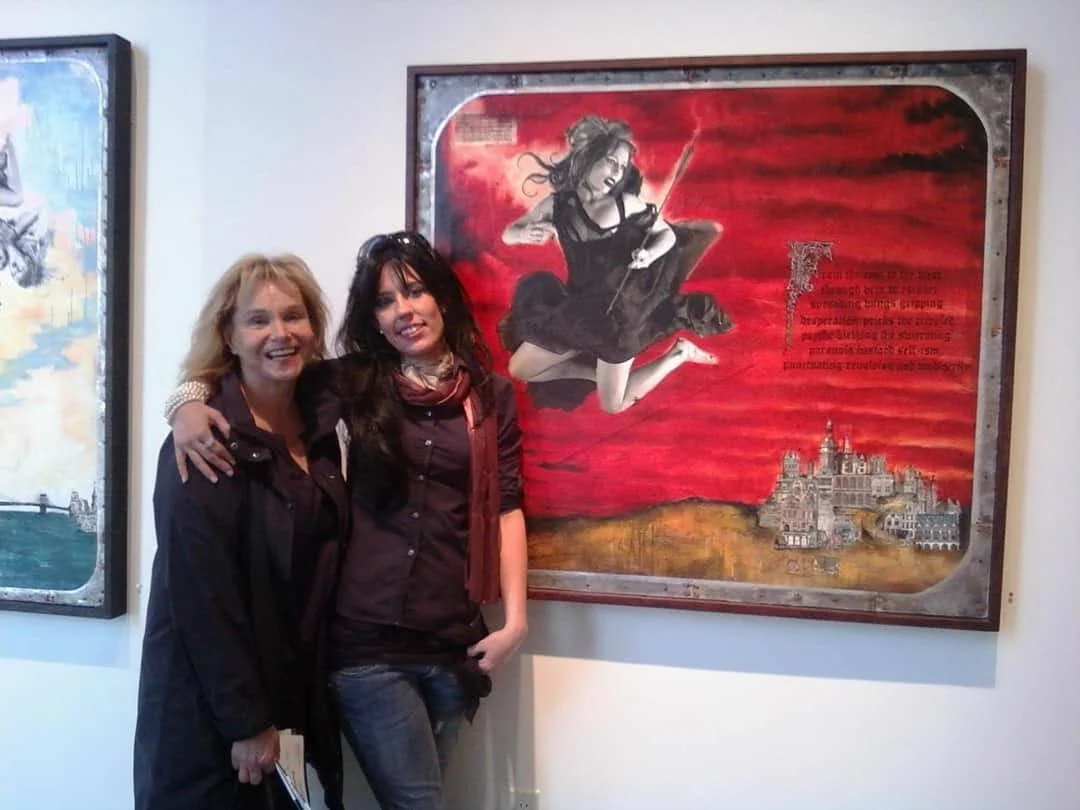
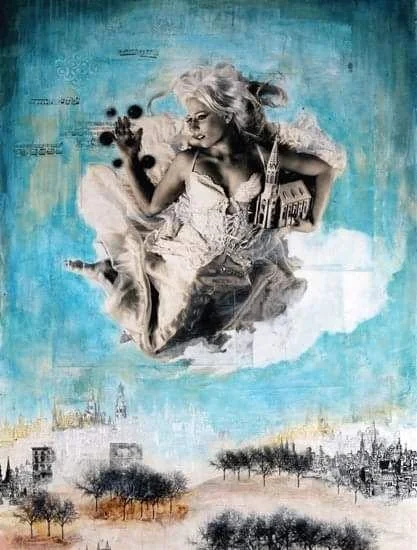
Oh but sweet, beautiful, New York. How she loved me! I was no longer living on the web; it had come to life all around me. It was February, 2007. The snow fell around me as I sat at my piano bench, painted, wrote poetry, sipped Pinot Grigio in my Brooklyn apartment listening to The Fray, dabbling finance positions in Brooklyn and on Wall Street. I read at the Nuyorican, The Bowery Poetry Room. I ran into poets on the subway who knew my lines by heart and stopped me to say so. We followed each other online, inspired by poetry uploads on Youtube. Somehow, despite all of this, I still did not believe writing could be my future. My mother’s opinion remained firmly seated on its throne. I modeled in $15,000 paintings that were on exhibition in L.A. and Germany. Thanks to internet archives at galleries like Corey Helford, you can still see them. I recently discovered that one artist used an old nude polaroid of me to create a new piece. It’s huge. It was at his opening in New York City last year. It’s actually quite beautiful. If I’m going to be in something immortal - let’s have it be thus. Also, I hope all you young ladies are taking note of how permanent some of your impulsive decisions can be when you make friends in the art world.
Facebook opened to non-college students while I was there, and I joined gladly, documenting nights that blurred into mornings, rooftop photoshoots in Brooklyn, collaborations that felt momentous at the time. The internet became my archive. It was proof that I had existed intensely, if briefly. I Irish danced at pubs in Hell’s Kitchen and did swing dancing to big bands along Broadway. I went to underground parties in Soho, The Village and the Lower East Side.
I met souls oozing with talent and passion. I loved decorating my online pages with recent creations and new sounds I was constantly finding. I loved sharing the outfits I was creating, tearing, stitching, gluing. I even wound up at FIT for a little while. But the fact is, draping is really fucking hard when you party as much as I did that year.
When I left New York, the web kept me tethered to the life I had abandoned the summer of 2009. At my parents’ house, I stayed up all night on MySpace video chat, talking to friends in England and New Zealand. We made music together across hemispheres. Beats sent as digital files, poems sent back as voice, collaboration without bodies and across oceans took place. I raided my parents liquor cabinet, counting the days until I decided to save up to go back to New York. On the upside, I discovered how absolutely horrible gin is. I wound up art directing photo shoots. The first one I did was with the director of the New World Miami Cinema Center. It bore fruit that I think got sold through the photographer to the Miami New World Erotic Art Museum, all thanks to my broken camera, some awesome friends and an interesting looking stairwell.
Luckily, the design district still had art parties and spoken word events. Many of them. All promoted on the wonderful world wide web. An elitist in the scene, Danny, would tag me in a flyer without even asking if I was available, knowing I would show up because other people were expecting me. It was sneaky. And totally effective. I always told my friends to bring their cameras and we traveled with what we called Art Party in a Bag. We made that thing legend.
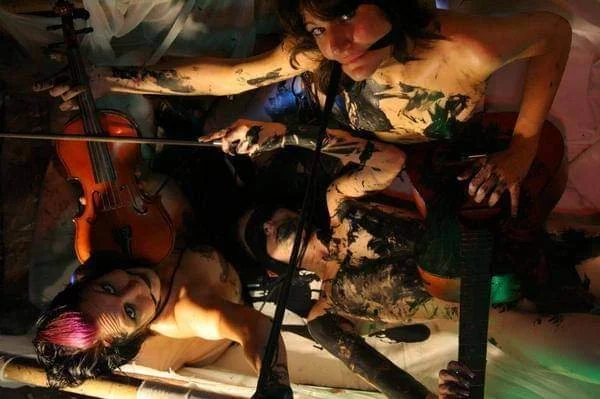
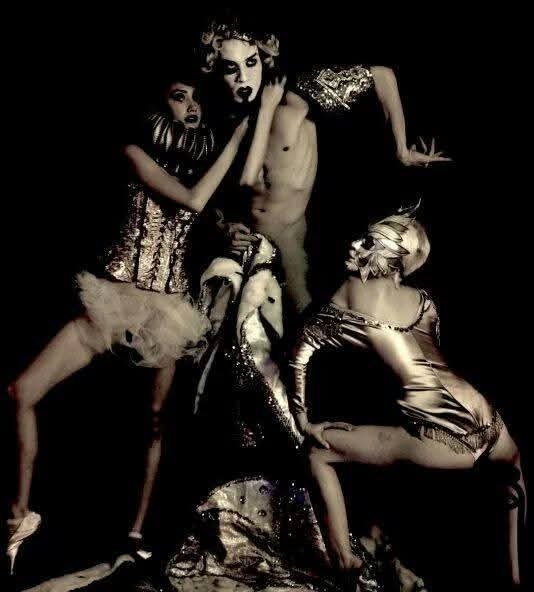
We had wild photo shoots, man. I was able to connect to other artists through social media, sending portfolio samples. Social media showed you who your shared friends were, which gave me access. I connected with the Miami artists. The New York artists. The Burning Man artists. Mseasy. Wildchild. Kiko. Hochbaum. Achilles. I met many in person as well. I loved taking super shy, introverted photographers and throwing them into a room of avant gard madness, nudity, paint and all kinds of interesting fabrics and lights.
Photo Credit to Fabi Jimenez and collaborative credit to Sean Fountain/WildChild
One time, I covered a model who had a shaved head with elmers spray glue and flour to look like a statue. It was fucking epic. Poor thing took days to get it all off though. Again, I got to promote the shots on the internet. I was going to turn them into photography constructionism paintings, inspired by an artist I modeled for in New York. But I never really nailed the photo transfer process the way he did. He went to the Boston School of the Museum of Fine Art, which is apparently more advantageous than the Youtube offerings I had access to at the time. I was like a guitar you tried to play with a violin boa, blindfolded. I actually directed a photo shoot at a bar called Black Sheep at 5am after leaving an art party to illustrate that exact thought. My friend was like “no. I need sleep. We’re going home.” He wound up thanking me for persuading him. Sleep is temporary. Art lasts longer. And we made lots of it, but it didn’t pay much at the time. An old friend said, “but we were so free.”
Photo Credit to XelaZaid
I decided to stop all my debauchery and flush all my meds from the celebrity doctors in New York down the toilet in 2010. You know what I learned? Don’t ask the first friend you have for his doctor's number. That’s what I did when I moved to New York. Turns out, he happened to be a world famous musician with a doctor who would give him anything. They’re called “celebrity doctors.” I received this precarious toxicity by proximity. Things got pretty crazy after that.
The clear mind I had after eliminating them was wonderful. I took a break from the web and hopped in the pool. I started laughing again and enjoying fiction for the first time in years. Relationships had more meaning. Connection felt more human. Even my poetry was sweeter.
Then, about a year later, I got violently sick.
For nearly a decade, the internet became both my lifeline and my torment. It was my only access to the outside world and a relentless feed of everything I was missing. I watched friends graduate, marry, earn doctorates, open practices, buy homes, travel. Get published, hold solo art openings, move to Europe. Meanwhile, my days narrowed to increments of pain: the next twenty minutes, then the next. The web taught me endurance, but it also taught me comparison. What writing for the web has shaped most deeply in me is not productivity, but perception. I learned how identity fragments, how voice performs, how survival can look like posting pictures of my socks at three a.m. to feel less alone. I learned that the internet does not replace embodiment. It exposes its absence.
I was completely healed in 2020 and life began to resurrect in every conceivable way. A holy force of pure love had healed my heart and given me joy, health, love. TV became obsolete. I stopped scrolling. I began waking before sunrise to ride my bike along A1A to go surfing at sunrise, riding home barefoot with salty wet hair and freedom in my bones. I wasn’t just physically healed in every way but I became spiritually transformed by a Holy Spirit of pure ecstatic love that introduced me to myself, my true authentic being. I began to dance again. To run, bike, surf. I learned again the language of joy, how to move without fear, how to live without bracing.
At night, I floated, a small body on an endless sea... bobbing like a cork beneath the moon, held in a peace so complete it felt like being known.
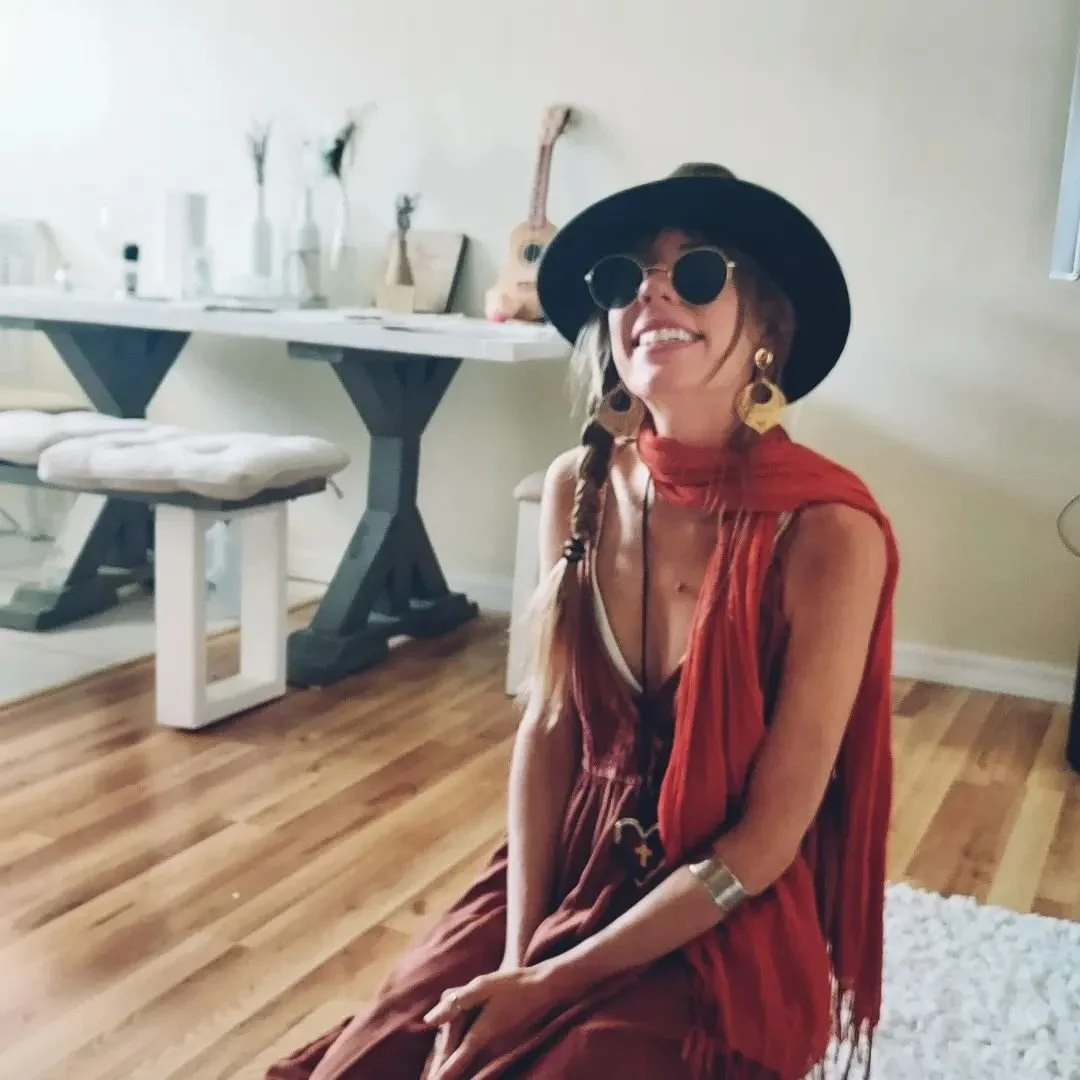
Now, I’m getting a degree in writing all these years later. All the years that passed, poetry never stopped pouring out. I was coming into a deeper knowledge of who I really was, shedding every pretense and false construct I had raised up in defense of a merciless world. I have been published three times in literary journals thus far.
Here I am in 2026, a few years past the intial birth of AI and my own admitted addiction to social media, at times. There’s the urge to zone out from everything and watch videos of baby goats. But hey, here I am. I’m not only studying to write, I’m studying to teach. Life has a serious way of being ironic. And guess what? I’m helping direct photo shoots. I’m the head of an Artist Alliance. I want these kids to experience true creative freedom and sharing of resources. I hope the artistic community here lasts long after I’m gone. And the web is here to promote, to share and to have AI distort everything you do, if you want.
Now, I am more cautious with the “I” I place online. I understand that attention is not neutral, that platforms reshape the self they host. The web raised me, scattered me, helped me survive and asked for more than it ever gave back. Writing within it has made me vigilant, not just about what I say, but about what I allow myself to become.



The Bohemian Hymn
Ralph Waldo Emerson’s “The Bohemian Hymn” is a brief but striking poetic meditation on the impossibility of giving shape to the infinite. Written at the height of his Transcendental period, the poem wrestles with a central tension threaded throughout Emerson’s prose: How can any human form, whether artistic, linguistic, or religious, ever hope to contain the greatness of the divine? If the Universal Spirit dwells within the human soul, then access to it is immediate; yet to measure it, to fully comprehend its magnitude, lies forever beyond us. This paradox animates Emerson’s essays “Nature” (1836), “The Oversoul” (1841), and “The Poet” (1844), as well as his private journals, where he consistently examines the boundless availability of the divine alongside the reverential awe produced by our inability to encompass it. Although he authored more than a hundred and sixty poems, critical attention has long treated his essays as the primary vessels of his philosophical theology, leaving many of his lyrics understudied. “The Bohemian Hymn” encapsulates his philosophical perspective yet has received little scholarly attention beyond a non-academic piece by Alex Leggatt. The poem offers a rare lyric crystallization of Emerson’s prose theology: through tight meter, anaphora, internal rhyme, metaphor and paradox, dramatizing the inability of human expression to grasp divine magnitude. Beneath this rhetorical performance, however, lies something more intimate: Emerson’s own attempt to express the spiritual awe of being, as he saw himself, a finite vessel filled with the incomprehensible breadth of divine presence. Thus, I argue that ‘The Bohemian Hymn’ is not merely a performance of ineffability, but a personal confession of spiritual magnitude that unites Emerson’s philosophy and lived experience.
Critics such as Alex Leggatt read the poem primarily as a rhetorical performance of ineffability, a hymn that dramatizes its own inability to utter the divine. Yet Emerson’s lyrics are more than just an exercise in simile and paradox. Beneath its confessions of linguistic failure lies a deeply personal articulation of spiritual awe, grounded in his belief in the immanence of the divine source through which his lived experience was drawn from. Alex Leggatt’s reading first directs us toward the poem’s structural paradoxes, arguing that Emerson uses apophatic theology to articulate divine un-representability. Leggatt observes that Ralph Waldo Emerson’s “The Bohemian Hymn” enacts a form of via negativa, naming various “forms” like language, art, prayer, and hymn to demonstrate the inherent hopelessness of representing divine significance. ¹ “The problem of ineffability continues to loom large. Emerson explicitly states that this Neoplatonic ‘union of man and God’ is ‘ineffable’ and beyond all ‘analysis.’
Leggatt and I come into agreement that “Having ‘lie[d] in the lap of immense intelligence’¹ and glimpsing into the underlying unity of all things, how can the “Poet-prophet” accurately convey these ‘undefinable [and] unmeasurable’ mystical experiences to readers in the imperfect medium of language, without their ‘speech becom[ing] less’ and lapsing into a final ‘noble […] silence?”¹ ⁷ Yet I see a deeper theme embodied in Emerson’s verse, one of the awe of a being that can simultaneously be the Universal Spirit in all things, the source through which all things are held together while also animating his pen and the cellists bow, the archer’s arrow, the psalmist’s cry, the mathematician’s genius. His reverence stemmed from the foundation of his philosophy.
Leggatt notes that because the poem is itself a hymn, Emerson’s decision to call it “Bohemian” signals a deliberate break from traditional religious structures, allowing his countercultural, anti-institutional spirituality to manifest directly within the poem’s form. ¹ In this way, I agree that the hymn becomes an embodiment of Emersonian self-reliance. Paradox, Leggatt argues, becomes Emerson’s method of mystical truth-telling, mirroring his belief that the divine communicates through hints, gestures, symbols, and subtle correspondences. ¹ While this reading highlights the rhetorical function of paradox and embodies the philosophical paradigm of writings such as “Nature” and “The Oversoul,” it overlooks the deeper theological conviction that motivates Emerson’s poetics. Emerson also writes about his very creativity stemming from The Oversoul, his thoughts and very being. ³ This is more than subtle hints and gestures but the very connection to the essence of divinity, artistry and love through which his life and genius thus exhaled. As Emerson has said, “When it (the Universal Being) breathes through his intellect, it is genius; when it breathes through his will, it is virtue; when it flows through his affection, it is love.” ² Emerson insists that creative genius does not source itself within the individual in possession or expression of it but rather, it flows from a divine source. ² Emerson’s poetry reflects his reverential humility towards this all-encompassing and benevolent Oversoul, transcendently present in all living things. ²
Emerson’s poetry, including ‘The Bohemian Hymn,’ embodies his transcendental theology even more intimately than his essays, revealing a devotional posture critics and scholars overlook. Emerson’s philosophy of transcendence is found in his essays, but his irrevocable adoration for the Spirit is deeply woven into his poetry. In “Wood Notes II,” Emerson illustrates this omniscient, omnipresent being of his essay, “Nature.” Alike “The Bohemian Hymn’s” use of Emersonian rhetoric showcases his worship of a divine being inherent in all living things, Emerson’s “Wood Notes II” encapsulates the transcendent nature of The Oversoul: “Whoso walketh in solitude /,And inhabiteth the wood, /Choosing light, wave, rock, and bird, /Before the money-loving herd,/Into that forester shall pass /From these companions power and grace; /Clean shall he be without, within, / From the old adhering sin; /Love shall he, but not adulate, /The all-fair, the all-embracing Fate, / All ill dissolving in the light /Of his triumphant piercing sight.” Emerson sees through the eyes of the Oversoul whose light contains its “piercing sight,” a theme embodied in “Nature,” for “I become a transparent eyeball; I am nothing; I see all.” ⁴
In his essay “The Poet,” further advocation for the themes present in “The Bohemian Hymn” are occupied. This includes his belief that the divine operates within the human soul and speaks through the poet and yet the poet cannot acutely contain it (nor any artist).³ Emerson does not merely dramatize the failure of language to capture infinity; he reveals his own awe before the God whose “greatness is unsearchable” (Psalm 145:3), and whose presence he described as the “currents of the Universal Being.”⁴ In this poem, Emerson acknowledges both the nearness of the Oversoul within him and the hopelessness of adequately illustrating that majesty. Emerson referenced King David multiple times, but alas, they were both psalmists in devotion of a creating, holy force greater than themselves. To Emerson, David’s psalms were no more or less divine than his own hymns and verse about this omniscient creator who has won the affections and attentions of his heart and mind. The very self-reliance Emerson wrote about, stemmed from his own unity to this “Limitless One.”
The poem’s meditation on divine infinitude becomes clearer when examined alongside Emerson’s broader Transcendental writings about the Oversoul. Ralph Waldo Emerson’s poem “The Bohemian Hymn” meditates on the impossibility of giving form to what is formless: the boundless greatness of God. In this brief but resonant lyric, Emerson acknowledges that neither language, art, intellect, nor religious ritual can contain the infinite. ¹ “In many forms we try / To utter God's infinity,” he writes, yet every attempt remains only an approximation toward the divine that can never fully reach its mark. This recognition aligns seamlessly with Emerson’s broader philosophy of the divine Oversoul: the idea that God permeates all things, resists confinement, transcending every living thing. ²
There is a vast necessity for other scholars to study Emerson’s poetry to truly understand the perspective of his philosophical position and movement; this relationship between the poet and the divine is central to Emerson’s self-understanding as an artist, shaping the theological and aesthetic logic of the hymn. Emerson himself understood his poetic “genius” not as something arising from his own selfhood, but as something moving through him. In “The Poet,” he famously states, “The poet is the person in whom the Universal Being becomes conscious,” grounding his creativity in a transcendent Spirit rather than personal ego.³ “For poetry was all written before time was, and whenever we are so finely organized that we can penetrate into that region where the air is music, we hear those primal warblings and attempt to write them down, but we lose ever and anon a word or a verse and substitute something of our own, and thus miswrite the poem.”³ Likewise, in his essay “Nature,” Emerson affirms, “The currents of the Universal Being circulate through me.” The poet becomes a vessel, a channel through which the divine passes. And yet, even as he claims to write by means of this divine influx, “The Bohemian Hymn” confesses that the grandeur of God forever exceeds the writer’s reach. “The great Idea baffles wit, /Language falters under it,” ¹ The Oversoul may speak through him, but even then, the infinite remains uncapturable.
To understand why Emerson feels this tension so acutely, it is necessary to situate the poem within the broader theological framework that shaped his spiritual thought. Understanding this poem benefits from recognizing Emerson’s Transcendental philosophy and his break from the theological orthodoxy of his day. He rejected the Puritan doctrine of original sin and embraced a Unitarian and later fully Transcendental philosophy in the inherent goodness and divinity within humanity. Scholar Jacob Wolf argues that Emerson’s individualism is “an inverted Puritanism—a Puritanism which has assimilated the doctrine of innate goodness into the place where the doctrine of original sin once resided.” ² While Christianity teaches that humans are born into Adamic corruption and reborn into the divine nature only through the atoning sacrifice of Christ, Emerson believed the soul to be “wholly pure” on its own.³ Rather than a regenerated state of reconciliation to the creator achieved through Christ’s death and resurrection, Emerson described divinity as native to the human being at birth, needing only recognition and awakening. This distinction separates Emerson sharply from Christian and Messianic Jewish soteriology, which holds that union with Christ’s death and resurrection destroys the sinful nature and restores humanity to the image of God (Genesis 1:31; 1 John 2:6; 1 John 3:6). Emerson embraces the outcome: a soul united with the divine yet rejects the mechanism of atonement. This is embodied in his words from “The Oversoul:” “The soul gives itself, alone, original, and pure, to the Lonely, Original, and Pure, who, on that condition, gladly inhabits, leads, and speaks through it. ² The belief in being made holy and incorruptible gave credence to the very reverential awe of his meditations.
Emerson’s literary influences further illuminate the poem’s interior spirituality and its resistance to institutional mediation. His affinity for Coleridge and Wordsworth reflects this orientation. ⁵ Wordsworth’s transformative encounter at Tintern Abbey and later his composition of more than one hundred ecclesiastical sonnets, exemplifies the kind of interior spiritual awakening that deeply moved Emerson. Though Wordsworth and Coleridge ultimately identified the divine they encountered as the Christian God, while Emerson named it the Oversoul, all three authors shared a profound belief in the accessibility and immanence of the divine. Emerson writes, “I am nothing; I see all; the currents of the Universal Being circulate through me; I am part or particle of God.” ⁴ Alike contemporaries such as Whitman, Emerson saw no separation between himself and the divine. Yet unlike Whitman who conceived of himself as the universal Spirit, Emerson was reliant upon it, as “part or particle of God,” yet saw no separation, making him “self-reliant” as much as he was dependent upon the Spirit within him as he was, air to breathe. ⁴ Emerson saw himself in authors like Thoreau, Hawthorne, Dickenson, Coleridge, Whitman and Wordsworth as vessels through whom the divine spoke through, directly to the human heart. He saw this creativity arising not from institutional religion or man’s ability but from spiritual influx. Despite this admiration, Emerson later expressed disappointment in his journal in Wordsworth’s preoccupation with repeated mentions of “sin” when the two met. ⁵
The poem’s imagery in “The Bohemian Hymn” reinforces its central theme paralleled by Emerson's explicit conviction that God transcends all levels of created existence: “But the boundless hath no form, / And the Universal Friend/ Doth as far transcend/ An angel as a worm.” It takes us a step further into Emerson’s reverence for this being. ³ Here, he asserts that God exceeds every level of creation, angelic or earthly alike. The scale is not merely vertical but absolute: nothing in heaven or earth can be compared to the divine in magnitude, essence, or form. The poem’s final stanza brings together its theological and philosophical concerns by asserting the ultimate insufficiency of human forms through verse. The poem’s closing lines deepen this theme:
“It leaves the learned in the lurch;
Nor art, nor power, nor toil can find
The measure of the eternal Mind,
Nor hymn, nor prayer, nor church.” ³
The content insists that even the most exquisite artistic forms fail before the infinite. Not only can no sermon, no painting, no sculpture, no poem, and no church capture the height nor width nor depth of the divine, Emerson’s theological point goes further. Because the Universal Spirit is immanent in all things, no institutional structure is necessary to reach it. God is accessible to every soul without mediation. As he writes in “The Over-Soul,” “The presence of the highest—God—is accessible to all beings.” ²
Ultimately, “The Bohemian Hymn” resolves its paradox not by seizing the infinite but by bowing before it. The poem becomes both confession and celebration: an acknowledgment of human limitation and an affirmation of the Spirit that moves through all things. In its humility, the hymn distills the very philosophies Emerson develops in “Nature,” “The Oversoul,” “The Poet,” “Self-Reliance,” and in his journals. It is a poetic embodiment of a worldview grounded in divine immanence. Leggatt is right to note the poem’s apophatic strategies, yet his reading captures only the surface of Emerson’s lyric devotion. When read in light of how Emerson saw the world and more crucially, how he saw God, the hymn reveals itself as a profoundly personal testament. It raises a final question: What does self-reliance mean for a man whose “self” is wholly dependent upon the Oversoul, who wishes only to be its conduit? Beneath Emerson’s celebrated independence lies a spiritual humility that makes the poem not a performance of ineffability but also, an act of reverent awe.
Emerson was forever reaching out and attempting to grasp some measure of this limitless force within him, within nature, within the universe, and at the same time, scaling it was forever beyond his grasp. He wrote in his private journal entry on December 19th, 1834, that “The maker of a sentence like the other artist launches out into the infinite & builds a road into Chaos & old Night & is followed by those who hear him with something of wild creative delight.” ⁵ Even a mind as brilliant as Emerson’s couldn’t use his beloved diction to illustrate the greatness of the divine. As an anonymous quote echoes, “The human heart feels things the eyes cannot see and knows things the mind could never understand.”
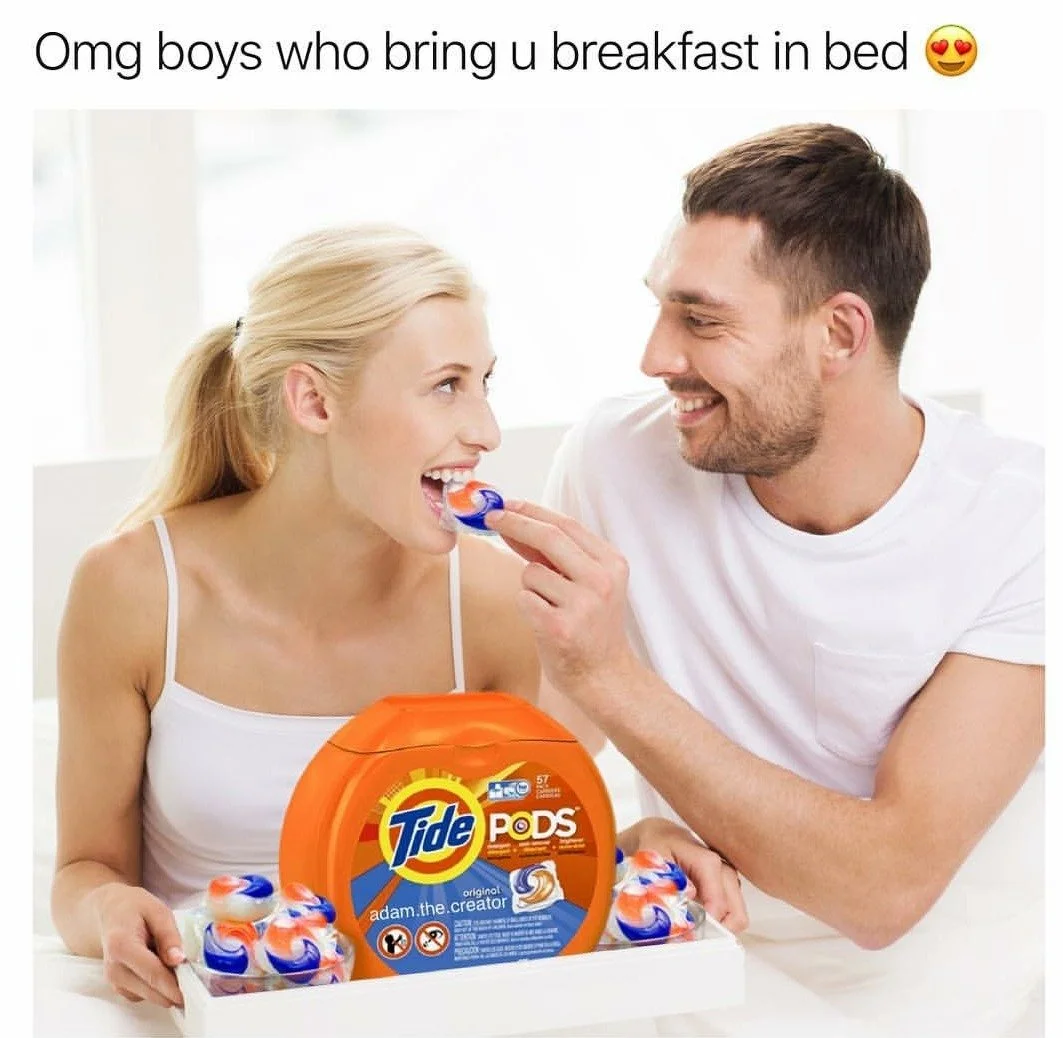
Remember the Tide Pod Meme Craze?
Tide’s origin story begins, as all respectable American legends do, in a lab in the 1930s, somewhere between the Great Depression and the Great Promise of Capitalism. Enter David Byerly, a Procter & Gamble scientist with the kind of jawline and determination you imagine only exists in black-and-white photographs and motivational posters.
Byerly was assigned to something called Project X, which already sounds less like detergent development and more like a classified government attempt to split the atom. His mission? To create the world’s first “heavy-duty” laundry detergent. Not light duty. Not moderate. Heavy. A soap muscular enough to wrestle your moral failures out of cotton. Seven years of experimentation later, the company shut it down. Presumably someone in a suit decided humanity was not yet ready for this level of purity.
Byerly, patron saint of stubbornness, did not stop. He continued working in secret for fourteen more years, which is either heroic dedication or the behavior of a man who truly believed stains were personal. I picture him alone in a lab late at night, sleeves rolled up, whispering to beakers like they were misbehaving children. The world outside changed. Wars, economical shifts, entire nations rising and falling yet he still pursued the impossible dream: a soap that didn’t merely wash, but absolved. And then, one day, he cracked it. Not just a detergent. A revelation.
It promised redemption in granular form. It could lift grease, grass, wine, and perhaps even the faint, existential residue of living. When Procter & Gamble realized what Byerly had done, they did what empires do when they discover gold: they commercialized it. Within two years, this once-secret experiment was boxed in orange and blue and delivered into American homes like a sacrament. Thus, Tide was born. It was not here to merely to clean clothes, but to reassure a nation that nothing is permanent. The day’s visible evidence can be poured down a drain. And somewhere, in a lab long forgotten, a man probably stood back from a washing machine and thought: Yes. This will do.
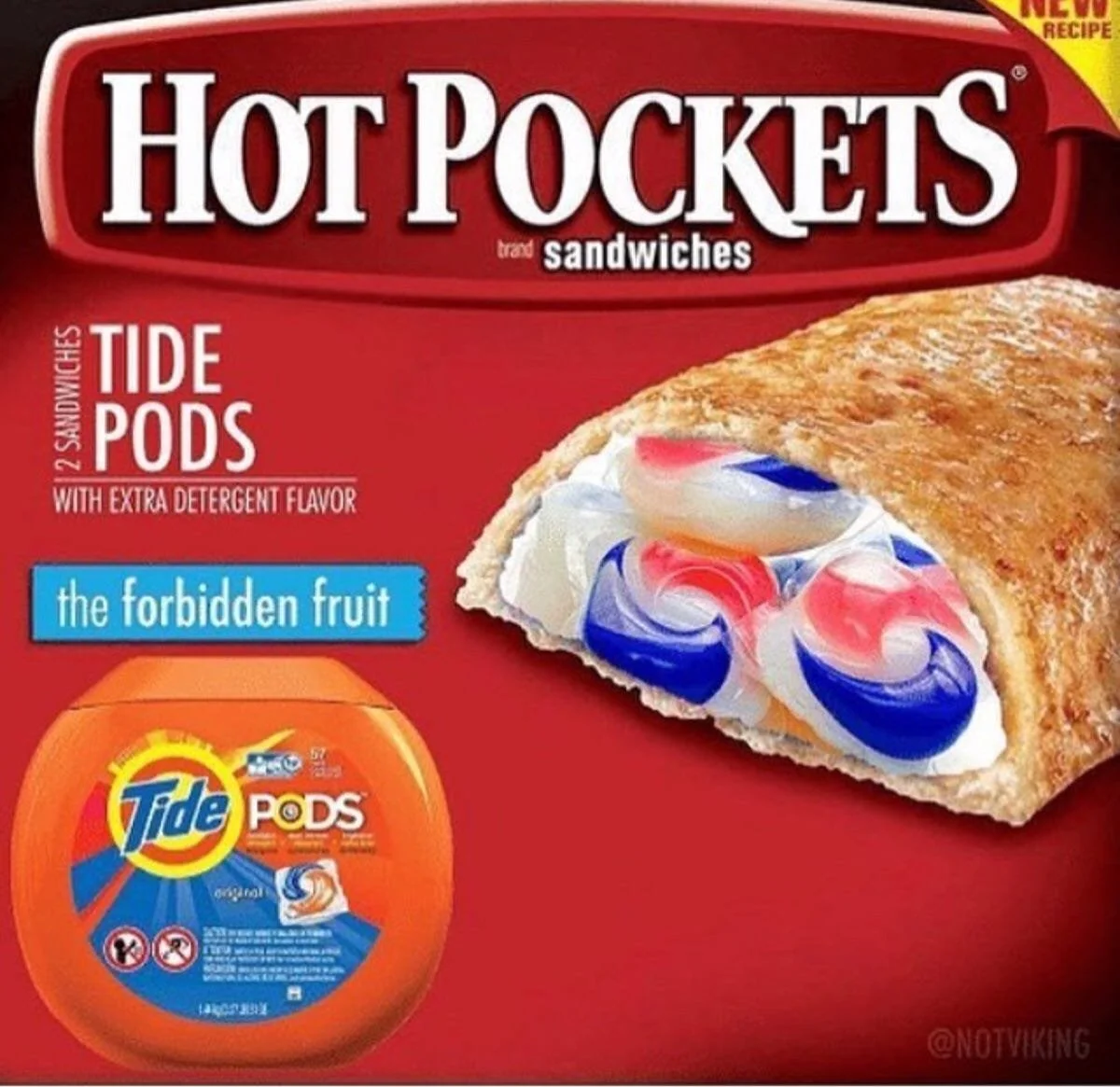
By 2012, enter Tide Pods. They were brightly colored, swirled like candy or gumdrops and wrapped in a glossy, gelatinous membrane. Almost immediately, people online joked that they looked like Gushers or fruit snacks. Cosmic candy. It was just a visual joke. So then, there was all this "don't eat this" humor by 2016-2017. People jokingly “rated” Tide Pods as food.
It wasn't literal encouragement, just absurdist humor meets irony culture. They made meme parodies of warning labels.
According to Harvard Medical School, it turns out the adolescent brain is still under construction. The frontal lobe scaffolding not quite in place, insight and judgment arriving fashionably late. Evolution, apparently, requires risk. But capitalism requires spectacle. And social media requires an audience.
Around 2018, a few teenagers ACTUALLY ingested Tide Pods, usually for dares and attention. It triggered ER visits, new CDC warnings and crazy news coverage. Official statements were released, schools actually sent written warnings home. It was ridiculous. So, of course, the meme exploded.
Once official press came out to actually not eat the Tide Pods along with PSA videos pleading “please don’t eat Tide Pods,” people were just comically obsessed. Tide even released a commercial featuring Rob Gronkowski telling teens not to eat the Pods. The memes were to mock the panic and expose the gap between the irony of the whole thing and the fact that it literally happened.
The PSA videos begged. The headlines multiplied. The joke, having completed its transformation into national concern, reached its peak.
And in the end, a brightly colored capsule meant to wash away the residue of living briefly revealed how easily spectacle swallows meaning. Somewhere between absolution and algorithm, detergent became diagnosis. The soap meant to rinse the day clean ended up reflecting it instead.
The biggest stain wasn’t on the fabric. It was in the feed.

Mission Statement on the Ethical Integration of Generative AI in Writing Instruction
By Kacie M Doran
In an era increasingly shaped by generative technologies, the role of the writer is not diminished but redefined. This mission statement affirms a collegiate pedagogical philosophy in Fiction and Creative Nonfiction curricula that is grounded in the belief that artificial intelligence should not replace human creativity, but rather refine and deepen it. Writing, at its core, remains an act of human expression. Composition is ultimately an encounter between thought, language, intention and lived experience. The integration of AI into writing instruction must therefore be guided by purpose, discipline and intellectual integrity rather than convenience.
In my classroom, writing begins by hand. This is not an exercise in nostalgia, but a deliberate commitment to cognitive development and authorship. Students will draft in green books and blue books, engaging in slow, intentional composition that requires them to confront their own thinking without mediation. This stage is foundational: it ensures that ideas originate with the student, that language is wrestled with rather than generated and that voice emerges through intellectual process rather than automation. Generative AI enters the students' efforts as a tool for revision, analysis and metacognitive growth, not a replacement for the cognitive functioning of composition execution. Students will use AI to identify patterns in their writing, to examine recurring grammatical or syntactical tendencies and to receive articulated feedback that supports their development. In this sense, AI functions as an analytical mirror reflecting the student’s work back to them with clarity and inspiration, never replacing the act of creation itself. At no point should AI be used to generate initial drafts, as doing so undermines the development of the very skills writing instruction is designed to cultivate.
Rather than prohibiting AI outright, this approach establishes tiered expectations based on assignment goals. For early drafts and in-class writing, AI use will be restricted in order to preserve the integrity of skill acquisition. For revision stages, however, AI will be permitted and encouraged within clearly defined boundaries. Students will learn not only how to use these tools but how to question them, critique them and understand their limitations. The goal is not technological dependence, but informed, critical engagement.
Central to this mission is the belief that students must become active participants in their own development. They will be trained to analyze multiple ways of constructing a sentence, to study stylistic variation and to engage deeply with mentor texts drawn from a wide range of authors, including those within the Western canon and beyond. In keeping with long-standing pedagogical practices, students will be encouraged to imitate styles as a means of discovering their own voice, experimenting with mentor writing style, voice, rhetoric and tone. AI may assist in analyzing these styles, but it will not replace the interpretive and creative labor required to internalize them. They will have to continually keep a journaled log of what they adopted from AI and why, continuing to preserve both drafts. We will keep both drafts on hand during workshops to encourage the student in areas where their own voice shines brightest.
To ensure that learning remains embodied and demonstrable, students will periodically rewrite revised work by hand, applying the techniques they have studied and practiced. These handwritten assessments will serve as evidence of skill acquisition, reinforcing that writing is not merely a product, but a practiced and transferable ability. In this way, AI use becomes self-regulating: when students recognize that overreliance on AI weakens their ability to perform independently, its misuse becomes counterproductive rather than tempting.
This mission also acknowledges the broader realities shaping contemporary education. Students are already immersed in a world saturated with digital tools and attempts to enforce absolute prohibition often lead to disengagement, dishonesty and a breakdown of trust. A blanket “no AI” policy fails to prepare students for the environments they will enter as professionals, where such tools are not only present but expected. Instead, educators have a responsibility to model ethical use, to establish clear boundaries and cultivate discernment. At the same time, this approach resists the uncritical embrace of technology. The goal is not faster writing, but better thinking. AI should expand a student’s capacity to reflect, revise and polish without diminishing their originality or replace their intellectual labor. Writing is not simply the production of text; it is the development of thought. Any tool that bypasses that process ultimately impoverishes the writer.
This philosophy is also informed by an awareness of the diverse needs of students. For those with learning differences like dyslexia, AI can serve as an empowering tool, enabling clearer expression and greater confidence. When used appropriately, it democratizes access to communication without compromising the authenticity of ideas. In such cases, AI does not replace the writer; it removes barriers that have historically limited participation. Journals will be submitted at the end of each period requiring them and with their respective assignments.
Finally, this mission affirms a forward-looking vision of writing instruction. Just as past generations adapted to the introduction of calculators, computers and the internet, so too must we adapt to the presence of generative AI. Resistance alone is neither sustainable nor productive. Instead, we must “hedge the future” by equipping students with the skills to navigate technological change with integrity and discernment. True artists and thinkers will continue to create. And not because they lack tools, but because creation is intrinsic to human nature. AI may accelerate or expand that process, but it cannot originate it. Ultimately, the aim is to cultivate writers who are not only skilled, but self-aware individuals capable of crafting, revising, and defending their ideas with clarity and confidence. Students will become, in every sense, the authors of their own work: not passive recipients of generated text, but active composers, art directors, editors, writers and thinkers. In this framework, generative AI is neither enemy nor savior, but an instrument. In this way, it is useful only as an educational tool insofar as it serves the deeper work of human expression and the acquisition of knowledge and skill. The goal, afterall, is to make better writers and thinkers.
Michigan Summers
We are the air passing through the jet engines of a Northwestern 747 every summer. We are reassured by the pilot’s voice. We are in the ascent from South Floridian humidity through the long wait of being small and contained and restless.
We are the wing pins won by unaccompanied traveling children descending into Detroit Metro Airport. We are the sudden rush to unbuckle, to stand, to inch forward in that narrow aisle like it matters. We are running down the long gray tube from plane to building, back when you could still meet people at the gate, back when love waited on the other side of a runway door.
Grandparents wait for us in high-waisted polyester slacks, arms already open, smiles wide, as if we have returned from something harder than a two-hour flight.
Maybe we have.
We forget the tumultuous life in Florida we left behind. We are deep in root beer floats and footlongs, the hum of A&W or the bright red of 50’s McDonald’s trays or the unspoken disappointment of the Ram’s Horn. Why does Ryan get to choose?
Ketchup stain on the clothes. Grandma wiping the stain profusely. If we go home with it, she’s a failure and she knows it. Scrub harder.
We pull up on Chatham and walk through the door. We are love-mauled by their black and white collie, Tippy. We are safe. We know that no harm will come, not too harshly. This feels like home. We feel wind blowing through the open window. The fan moving side to side. I speak into it: Luke, I am not your fa-aa-aa-ther. Every time. We hear the Tigers playing on TV, the announcer's voice echoes into the living room. We have no idea what inning it is, but it feels like summer. Familiar. Safe.
We fill the blue circular pool with the hose. We never decide if we like the pool or the sprinklers the best. We chase the dog. We rummage the garage. We ride rusty old bikes from the 50’s, rolling down Detroit sidewalks, the rhythm of uneven pavement beneath us. Grandma brings tomatoes in from the garden to have with fresh corn and pop for lunch.
We run downstairs to the basement to search for unknown treasures. We never know what we’ll find. The cool air hits us, a welcome change from the July heat. We discover the boxes to Lincoln Logs. Mom’s old dolls. We are relics of the past, like these toys, engulfed in the playtime joys of the 1960’s. We are filled with the thrill of finding something that existed before us. We watch The King and I over and over and over again. The first one.
We draw flowers with chalk on the sunlit sidewalk. We are greeted by cousins coming over. Swingsets. Family gatherings in lawn chairs. We eat casseroles and smell smoke everywhere. We chase fireflies and put them in a jar.
Soon enough, we are greeted by Dad. We climb into his car filled with the aroma of that new car smell. He chews half a piece of Trident. Your mom’s family are a bunch of hillbillies. We don’t understand what that means. He drives us as we sit on the pristine leather seats as he swears at other drivers. We eat Buddy’s pizza and see old horror movies we’re too young to watch. Dinosaur blankets on the bed.
We take his plastic cups and old folding table to the corner to sell lemonade, the kind that comes from a freezer can and tastes like victory.
We hear Dad say we have to bring the cups home. Red. Plastic. Disposable.
We don’t ask why.
We are greeted by the guy from the video store tying balloons to our stand like we’ve opened a franchise.
Matching outfits, sticky hands, the pride of earning something small.
We are dunking the cups in a bucket of water between customers, one quick swirl, good as new.
We are operating in sustainability before we know the word. We are probably not using soap. We are judged by the one mom, horrified, eyes widening as we ask for the cup back when she’s done. She watches us freshly baptize another cup in water,“C’mon, honey. Let’s go,” grabbing her daughter’s hand and fleeing.
We watch them leave. We are indicted. We are trying to remember if we used soap.
We are pretty sure we didn’t. We don’t know anyone else who reuses plastic cups. “We will need that back, Sir.”
We are in the hot summer sun, always creating our own fun out of whatever is left behind.
We are somewhere between places, always.
Red Soil
Published in From the Fallout Shelter, Spring Issue 2026
The autumn Irish wind exhales,
pressing its weight into my chest.
I walk past the murals of the hunger strikers.
They stare, as if stone could speak.
Bobby Sands went sixty-six days without food,
a prisoner, a parliamentarian, confined to a cell on H Block,
a soldier starved for the right to be heard
in a war that’s raged for over eight hundred years.
Cousin Geraldine would visit them at Long Kesh.
"Don’t let them break you."
They refused the rags of criminals,
refused the bread of surrender.
I would sit at her table, a cloth etched with blossoms,
where I was told the blood of this battered soil
beats like a bodhrán drum,
etching its sound into my bones.
I taste Irish potato bread, still warm,
its aroma entwined with curling smoke
and Punjana English tea,
kindling memories of my granda’s last letter:
"I’ll come home to Lurgan when all of Ireland is free."
Six feet beneath a foreign sky,
his bones lie still in the land that birthed me.
Geraldine taught me how to wear makeup—
how to trace the dark lash-line of my inheritance,
and that Aunt Sheila,
who spoke only Irish to soldiers,
was a real Irishwoman, a true rebel.
"And what are you?" the wind whispered,
as it kissed the gravestones
of those who bled before me.
Through Belfast’s subterranean markets,
I wander the tunnels where many hawk fleeting trinkets,
drowning my sorrows in too many pints.
I walk among ghosts past the gates of Lurgan Cemetery,
where names are etched in weathered stone,
a litany of loss, a hymn of bones.
My cousin traced the dates with reverent hands,
whispered of martyrs, rebels, saints—
said the blood that once stained this soil
still sings within my veins.